
Friday, February 22, 2013
Les Brown, Huntsman Gay Global Capital

Last week we were privileged to have Les Brown come and teach us about work-life balance. Les Brown is the COO, CFO, CCO, and a partner at Huntsman Gay Global Capital. He first took time to explain his background. He got his masters here at BYU and worked a lot with Professor Budd in Beta Alpha Psi. He wanted to encourage us to use all of the resources that we have here at BYU. We have so many great opportunities at BYU.
Work life balance is a hard thing to find when you are in the profession of accounting. It is in the nature of the profession to be into work early and go home later than the others because we are the custodians of the business’ assets. It may be hard to find a balance, but it can be done! Les gave us four things that will help us become better professionals, students, and family members with balance in our lives.
The first thing that Les spoke about is the need Manage our Expectations. To do this we need to communicate with our colleagues at work and with our families at home. Let them know what you will be able to do for them. He also found that it is common for most people to over promise and under deliver. We need to overcome this habit so that we do not have as much time pressure from both sides.
The second point is that we need to Make Time for Family, be Present When you are There, and Keep Appointments and Promises. Just like the Mormon ads used to read “Family, isn’t it about time?” When we are at school, home, or work we need to focus 100% on what surrounding we are in. If in the office, be in the office. If it is family time, be with your family.
The third point is to Distinguish Between the Importance and Urgency of the Tasks you Have in Your Life. Les referenced Steven Covey’s Book “7 Habits of Highly Effective People.” Here is a link to some quotes from other sections of the book. http://www.brainpickings.org/index.php/2012/07/18/steven-r-covey-quotes-7-habits-of-highly-effective-people-quote/. Importance is related to activities that lead to our personal and professional goals. Urgent is related to activities that demand immediate attention and are often associated with the goals of others. We have four sections in the urgent-importance chart.
- High importance and urgency: Critical Actions, We do not want many of these, do not procrastinate, and set aside some time to deal with emergencies
- Low importance and High urgency: Interruptions, these happen, learn to say politely say no or not now, or you can set a time when people can bring you their questions.
- Low importance and urgency: Distractions, roadblocks to our goals; down time is good but it still hinders us from getting important tasks done. Avoid if possible.
- High importance and Low urgency: Essentials to your goals, where you want to spend most of your time. Plan time every day where you can focus on these activities.
The last advice he wanted to give us was to Identify and Emulate Effective Role Models. He gave us nine great role models by showing us a clip about “The Mormon Way of Doing Business: How 9 Western Boys Reached the Top of Corporate America.”
Here is the clip he showed us http://www.youtube.com/watch?v=c-GllaD4FEM, and if you want to find out more go to http://www.fm.co.za/lifestyle/books/2012/11/01/the-mormon-way-of-doing-business and look around.
We have really great opportunities here at BYU, and Les ended the meeting with a few takeaways from the clip. The one that impressed me most was, “Be dedicated to the permanent titles that come along in life, the titles of Disciple, Follower of Christ, Father, and Mother.” These are the things that set us apart from other students and business professionals out there in the country. Live by the values that you have and take them to work with you. When we all try to live ethically, business and success will flourish.

BAP Planning Meeting
This week we had a discussion on how we can make Beta Alpha Psi better for us as members and for future students to come. We would like to let everyone know that our Beta Alpha Psi meetings are for everyone. Even if accounting students are not in Beta Alpha Psi we want to fill the room when we have professional speakers come and enlighten us.
Beta Alpha Psi is an amazing organization and professor Budd would like to thank everyone for being so willing to step up and take on assignments. The students are what make BYU Beta Alpha Psi great.
We talked a little about the introduction of a Mentoring Program, which will require a lot of volunteers. The planning is still in the works, but it has a lot of potential to make BYU that much better at propelling its' students into great careers. This program will help new Junior Core students to be able to see the full spectrum of career paths that they have open to them. Especially providing more visibility for firms other than the "Big 4."To help us out with the whole process we will be having an accounting interview meeting on the 27th of February at 4p.m. The location and more details will be provided in the upcoming weekly email.
Also remember that Bill Brady is here to help us out with our resumes and with interviewing skills. We can make appointments with him to give ourselves more experience with the recruiting process. We have so many resources here at BYU to help us out, we need to remember to use them. Good luck to everyone in this semester's school work and recruiting!
Sunday, February 10, 2013
John Donahue, Moss-Adams

Last Thursday Beta Alpha Psi was honored to have John Donahue, a partner from Moss-Adams, present at its weekly meeting. Mr. Donahue joined Moss-Adams in 2002, and recently completed a rotation within the Office of the Chief Accountant of the SEC. During his presentation, Mr. Donahue talked at length on IFRS convergence within the U.S., and also shared some of his experiences serving as a Professional Accounting Fellow within the Office of the Chief Accountant.
The Office of the Chief Accountant serves as the “national office” to the Securities and Exchange Commission. While living in Virginia, Mr. Donahue assisted in producing the IFRS “Work Plan” of the SEC, a document focused on the IFRS-U.S. convergence debacle. He also had the opportunity to work one-on-one with some of the largest companies in the U.S., and assist in standard setting oversight and rule making.
Mr. Donahue also shared some of the benefits and costs of U.S. adoption of IFRS. He noted that the greatest costs would hit mid-level and small companies. Many large companies already are using IFRS in some capacity due to the international nature of their business and subsidiary holdings. As such, a switch to IFRS would probably not cause much of a problem to them (and in fact, would probably be welcomed with open arms). But for smaller companies, who are mainly concerned with being comparable to other small companies within the U.S., convergence would be costly, and wouldn’t lead to very much gain in the aggregate—if any at all. He also noted the sheer magnitude such a switch would make within contracts and regulations alone, where U.S. GAAP is mentioned frequently. Such a change would require changes and updates to every one of those contracts, regulations, and similar documents—a major feat by any means.
As a bit of advice to the students listening, he taught that the best preparation for IFRS convergence is to have a baseline background of international standards prior to convergence actually occurring. While it is unclear when convergence will take place, having a basic knowledge of international standards to which we can hearken back will greatly assist us when IFRS adoption finally becomes a reality.
While the future of IFRS convergence is unknown in many ways, Beta Alpha Psi was grateful for the chance to learn from John Donahue about IFRS adoption, and gain his perspective on the issue as a whole.
Monday, December 10, 2012
Deloitte Sub for Santa Event

Have you ever wanted to go shopping with someone else’s money? And serve at the same time? Last Tuesday evening Beta Alpha Psi members were given that very opportunity as part of Deloitte’s Sub-for-Santa event.
Every year Deloitte sponsors gifts for the Marriott School of Management’s Sub-for-Santa program. Sub-for-Santa is an opportunity for people to donate or sponsor gifts for needy families during the holiday season.
Specifically, Deloitte donates the money necessary to buy their sponsored gifts for needy families, but the gifts still need to be bought before they can be distributed.

Enter BAP volunteers, who were more than happy to help buy gifts for others.
Their task: choose gifts they felt each child they were assigned would want this holiday season. From books, to winter clothing, to toys and games, fun was had by everyone as they shopped for those in need. Gifts will be distributed before the Christmas holiday.

Deloitte’s Sub-for-Santa event is one part of a larger project for needy families this season. Neither the families being benefited nor the students who served will forget the opportunity they had this holiday season to make each other’s Christmas brighter. But the most gratitude should go toward each and every Sub-for-Santa donor. This entire event is made possible by them.
Friday, November 30, 2012
Mind the GAAP
“Mind the Gap” warns every subway station of the London Underground—a guide for every passenger to be careful of the small yet treacherous gap between the train and the walkway. The accounting firms and governmental organizations are sounding a similar warning to preparers and users of financial statements: Mind the GAAP—not between a train and the walkway, but between US GAAP and IFRS GAAP.
BYU offers a fantastic accounting study abroad that teaches students about how they can best ‘Mind the GAP’ not only the gap between US and IFRS GAAP, but also the gap between cultures, the gap between countries, and even the gaps between people.
I remember stepping off the train in the gare d’est in Paris and being suddenly immersed in a new world. Within half an hour I was touring the city with several students who would become great friends. And that’s the best thing about the accounting study abroad—you are immersed in a learning experience.

Exploring Paris
James Embree, Reid Simmons, Blake Thain, Nick Brown, Randy Stucki, Leslie Macfarlane
Here’s what the accounting study abroad entails. You visit several picturesque cities whose beauty for centuries poets and painters have tried to capture, but only in vain. While touring these cities, you visit specific firms and organizations to learn about key global issues. Last year, we visited the European Commission to learn about the Green Paper on Audit Quality. This Green Paper was a key issue that was new and emerging and very global in its effects. Later on in the summer, while talking with an Ernst & Young Partner, this topic came up and he was very impressed that I had learned so much about such a ‘hot topic’ in the accounting world.
Another one of my favorite visits was to the IASB. We were able to meet with IASB fellows and learn about the new convergence on IFRS 9. We were able to sit in on a education meeting and see firsthand how they work through the accounting issues that come up. And let me tell you, it’s not necessarily what you expect. They joke they argue, they discuss all while you are sitting right there.

Brussels, Belgium
Now the accounting abroad certainly isn’t all work and no play. In fact, I was amazed by how much time, and how much I learned, touring the cities. The students are given a lot of freedom to explore and investigate places that are interesting to them. There is a great balance between planned group tours to the local sites and personal touring time.

Stonehenge Replica
One of the benefits of doing this travel through BYU is that you can apply for scholarships and subsidies—making this study abroad one of the most affordable opportunities available to you.
So don’t be scared of an ‘accrual world’ go ahead and dive into the accounting study abroad. Apply today at the Kennedy Center website: Kennedy.byu.edu.
Post by James Embree
Thursday, November 29, 2012
Management Consulting Club
No comments
:
Labels:
professional meeting

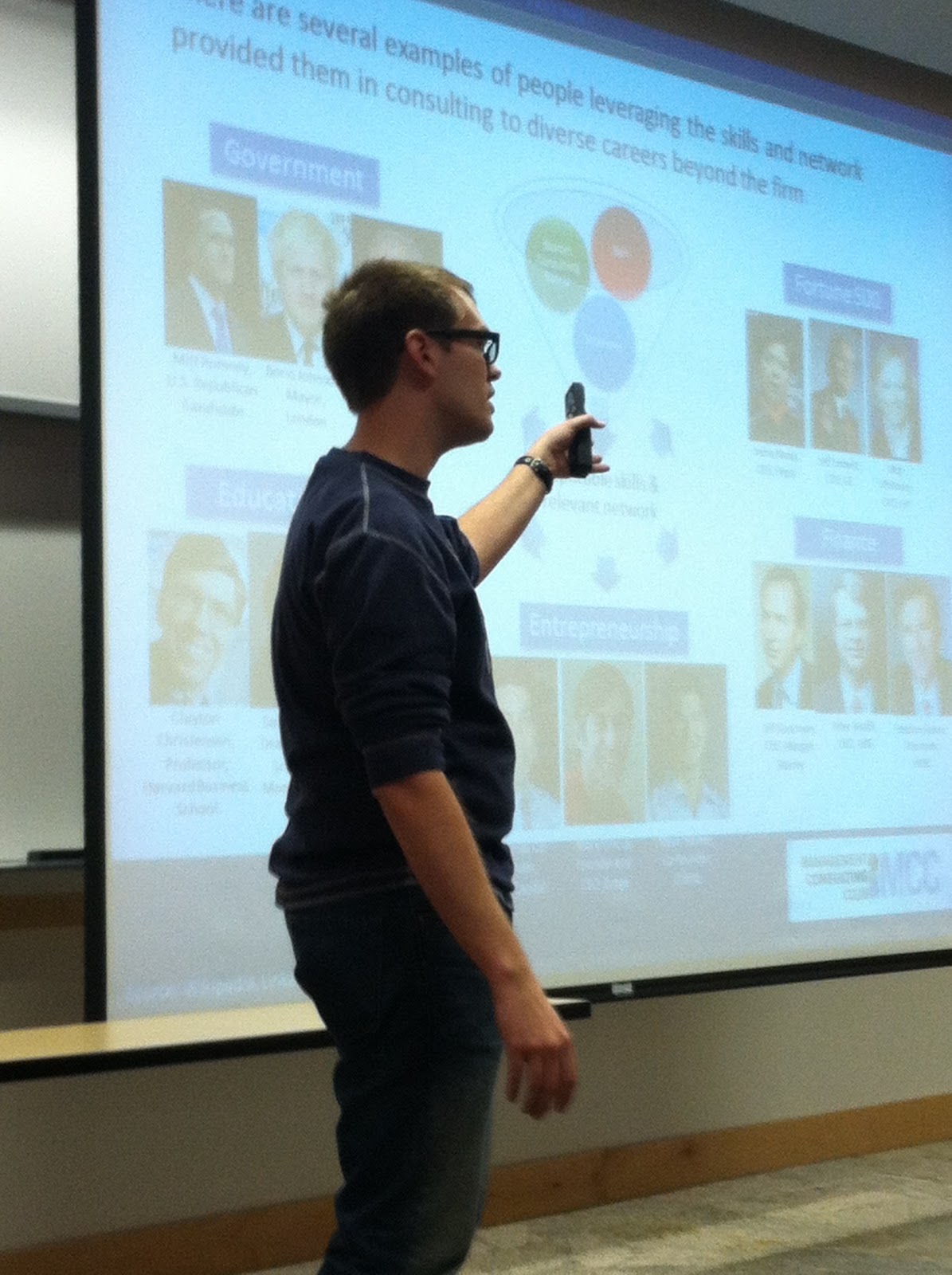
This last meeting Josh Angle, Steven Biringer, and Johnny Stoddard came from the management consulting club and introduced us to some options that we have in relation to career paths. Their main message was that “Not All Roads Lead to Public Accounting.”
Josh started and talked about the Trifecta for Success in any career path.
- 1. Academics, we all know that it is important to do your best to get good grades, and gain wisdom.
- 2. Leadership, Josh said that we are kind of on our own to improve ourselves in this area. Club officer roles in BAP and other clubs are great for this.
- 3. Experience, by getting out and getting involved with clubs, getting internships, networking with professionals, etc.
Josh wanted to make clear that there are some myths around the experience section that need dispelling. The first myth is “my resume is good”. If you still use your M Com 320 resume this most likely applies to you. The Management consulting club can really help in this area. They have resume workshops and professionals that are happy to help revise resumes.
The second myth is that “you need an accounting internship with the big 4.” There are many opportunities with management consulting firms, firms in industry, and other branches in the big 4 that are not just audit and tax internships. We really need to look around and see where we want to be.
The third myth is “getting a MAcc is right for everyone.” This also goes back to looking where you want to go with your career and choosing the path that will get you in the best position to get there. In short, management consulting is a great path to get an MBA, 20% of MBA students have a management consulting background.
Johnny showed us that, like audit, there are many facets of business that management consultants touch. Management consulting is a good option to find out where you want to end up if you have not yet decided. The skills that you learn in management consulting, like problem solving can be applied to many different career paths and will give you a leg up on others.
Steven told us about the management consulting internship that he did at Bane Capital. He said that he worked an average of 60 to 65 hours a week. They go easy on interns, but full-timers do not work much more than 70 to 75 hours a week.
The management consulting club can help you prepare for the competitiveness of the field. If you are interested and think you have what it takes to think out of the box, be teachable, and are smart, then they invite you to come to the management consulting club meetings, Tuesday evenings around 6:00 in the Tanner (room 230). You can find out more on mcc.byu.edu.
The main purpose of this meeting was to encourage us to look around, research where we want to go, and then make conscious, intelligent decisions to get ourselves there. It was so great to hear from accounting students just like us who have already made important decisions to change their career paths.
Subscribe to:
Posts
(
Atom
)


